


Page 30 - Koi Net - On-Line Koi Magazine - Issue 83
P. 30
were thinning, as quite a few people travelled home
                             after the show, but we enjoyed the evening, nonetheless.
                             We looked forward to the Monday mystery tour
       WE LOOKED             arranged for us. Last time we were in Taiwan, we were
       FORWARD TO            taken to a beautiful museum housing a whole range of
                             incredibly valuable and ancient items brought out of
       THE MONDAY            China from the Forbidden City for safekeeping after
                             Japan invaded in the 1930s and never returned. We
       MYSTERY               were also taken to a coastal area with some very
       TOUR                  famous stone “mushrooms”, huge rocks shaped by
                             wind and water probably thousands of years ago.
       ARRANGED              However, this time we were in a completely different

       FOR US                area of Taiwan, so we had no idea what to expect.
                             We duly boarded a bus on Monday morning and were
                             taken on a tour of Hsinchu (New Bamboo). We went
                             first to a remote cultural site in the mountains where the
                             entire industry is in growing, harvesting and drying
                             persimmons. These were different in shape from the           Above:
                                                                                          The Hakka village entrance
       Right:                                                                             and square.
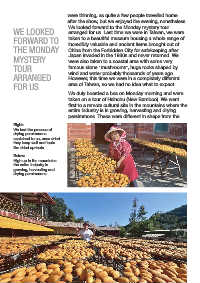
       We had the process of
       drying persimmons                                                                  Right:
       explained to us, once dried
                                                                                          The local Hakka ladies are
       they keep well and taste                                                           well known for their strong
       like dried apricots.
                                                                                          sense of identity, unique
                                                                                          culture and language.
       Below:
       High up in the mountains
       the entire industry is
       growing, harvesting and
       drying persimmons.
                                                                                                                 fruit we see in Australia, shaped more like plum
                                                                                                                 tomatoes, elongated and smaller than the usual variety,
                                                                                                                 which look more like large, smooth-skinned mandarins.
                                                                                                                 Once dried completely, they keep well and are very
                                                                                          THE LOCAL              tasty, rather like dried apricots. The local people
                                                                                          PEOPLE                 involved are a significant ethnic group in Taiwan,
                                                                                                                 representing approximately 15 to 20% of the
                                                                                          INVOLVED ARE           population, culturally separated and speaking a dialect

                                                                                          A SIGNIFICANT          called Hakka. They migrated from mainland China
                                                                                                                 originally and are known for their strong sense of
                                                                                          ETHNIC GROUP           identity, emphasis on education and unique culture and
                                                                                          IN TAIWAN              language. We next visited another Hakka cultural area,
                                                                                                                 laid out like an entire village with interesting shops
                                                                                                                 and a very special museum showing old agricultural
                                                                                                                 implements, a huge statue in the centre (we had no
                                                                                                                 idea who it was meant to be but it was very impressive)
                                          16                                                                                  31

