


Page 65 - Koi Net - On-Line Koi Magazine - Issue 95
P. 65
THE KOI                                                                             There are a number of recognised patterns, but I won’t
                                                                                                                 complicate matters – this is a simple guide. Kohaku is
                                                                                                                 one of the three varieties that make up the Gosanke
                                                                                                                 group which take most of the major prizes at Koi
                             VARIETIES PART 1
                                                                                                                 Shows. The other two varieties are Sanke and Showa.
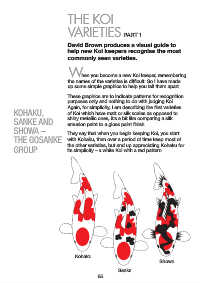
                             David Brown produces a visual guide to                                              If you imagine a Kohaku as a white Koi with a red
                             help new Koi keepers recognise the most                       COMPARE               pattern a Sanke looks like a Kohaku but with shiny
                             commonly seen varieties.                                                            Sumi (black) pattern creatively placed along its back,
                                                                                           BEKKO AND             like stepping stones to form a balanced pattern. A
                                                                                           UTSURI WITH           Showa looks like a Kohaku with matt Sumi running
                              When you become a new Koi keeper, remembering                                      around the body and with Sumi on the head, this gives
                              the names of the varieties is difficult. So I have made      SANKE AND             you the basic place of where to start.
                              up some simple graphics to help you tell them apart.
                                                                                           SHOWA                 Remove the Beni (red) pattern from the Sanke and
                             These graphics are to indicate patterns for recognition                             Showa and two more varieties appear. Bekko (a Sanke
                             purposes only and nothing to do with judging Koi.                                   with no red pattern) and Utsuri (a Showa with no red
                             Again, for simplicity, I am describing the first varieties                          pattern). The full name of these two Koi varieties are
       KOHAKU,               of Koi which have matt or silk scales as opposed to                                 Shiro Bekko and Shiro Utsuri. Shiro means white.
       SANKE AND             shiny metallic ones, it’s a bit like comparing a silk
                             emusion paint to a gloss paint finish.
       SHOWA –               They say that when you begin keeping Koi, you start
       THE GOSANKE           with Kohaku, then over a period of time keep most of
                             the other varieties, but end up appreciating Kohaku for
       GROUP                 its simplicity – a white Koi with a red pattern.


                                                                                                 Sanke
                                                                                                                                      Showa


                                Kohaku                                                                        Shiro Bekko
                                                                   Showa                                                                             Shiro Utsuri
                                                  Sanke
                                          65                                                                                  67

