


Page 68 - Koi Net - On-Line Koi Magazine - Issue 34
P. 68
fading light and our one-day time schedule running out!
                                                                                                                 We unfortunately didn’t have time to enter and visit the
                                                                                                                 temple’s main hall, but we will certainly be returning to
                                                                                                                 Nara again and make it our main stop!
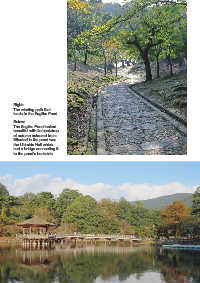
                                                                                                                 Ukimido Hall and Sagiike Pond

                                                                                                                 From Todaiji Temple we then headed south through the
                                                                                                                 park to the Kofukuji Temple, but on the way we spotted
                                                                                           UKIMIDO HALL          a path leading to the Sagiike Pond. The large pond was
                                                                                                                 calm with a beautiful backdrop of autumn coloured
                                                                                           APPEARS TO            trees, situated in the pond was the Ukimido Hall which
                                                                                           BE FLOATING           had a bridge connecting it to the pond’s bankside. It’s
                                                                                                                 quite striking and looks like it is floating on the pond
                                                                                           ON THE POND           surface. The Ukimido Hall is a classical hexagonal
                                                                                           SURFACE               shaped wooden pavilion, with a Japanese cypress bark
       Right:                                                                                                    thatched roof, and said to be a popular photo spot,
       The winding path that                                                                                     which it is! The pavilion was built in 1916 and
       leads to the Sagiike Pond.                                                                                completely reconstructed from 1991 to 1994 to its
                                                                                                                 former beauty.
       Below:
       The Sagiike Pond looked                                                                                   Kofukuji Temple
       beautiful with its backdrop
       of autumn coloured trees.                                                                                 After walking around the Sagiike Pond we then
       Situated in the pond was
       the Ukimido Hall which                                                                                    continued heading westerly to the Kofukuji Temple
       had a bridge connecting it                                                                                complex, taking about a 10 minutes’ walk. Alternatively,
       to the pond’s bankside.                                                                                   Kofukuji Temple can also be reached by the loop bus
                                                                                                                 from Nara Station.
                                                                                                                 The Kofukuji Temple grounds were quite large and the
                                                                                                                 majority is free to enter and walk around, there are
                                                                                                                 three areas that require an entrance fee, which are the
                                                                                                                 Central Golden Hall, the Eastern Golden Hall and
                                                                                                                 Kofukuji’s National Treasure Museum. As it was at the
                                                                                                                 end of the day, we unfortunately didn’t have time to
                                                                                                                 enter these areas and buildings, but they could still
                                                                                                                 easily be viewed from the outside.

                                                                                                                 The temple building was transferred from Kyoto to Nara
                                                                                                                 in 710, and founded in the same year, which was also
                                                                                                                 the same time the capital was established in Nara.
                                                                                                                 Kofukuji was used as a family temple for the Fujiwara,
                                                                                                                 who were the most powerful aristocratic clan during
                                                                                                                 much of the Nara and Heian Periods. At the height of
                                                                                                                 the Fujiwara’s power, the temple consisted of over 150
                                                                                                                 buildings, but power struggles throughout the years
                                                                                                                 caused fires and destruction of most of the buildings.

                                          18                                                                                  69

