


Page 71 - Koi Net - On-Line Koi Magazine - Issue 36
P. 71
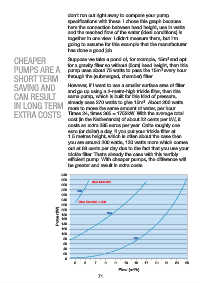
double stroke (compression and labour stroke) 2 litres of                           don’t run out right away to compare your pump
                             water is actually moved. It doesn’t matter what diameter                            specifications with these. I chose this graph because
                             is the pipe that’s connected to the pump. Let’s say you                             here the connection between head height, use in watts
                             can make 200 double beats per minute, you move 400                                  and the reached flow of the water (ideal conditions) is
                             litres of water per minute, or 24m³ per hour. The smaller                           together in one view. I didn’t measure them, but I’m
                             the diameter of the piping, the higher the pressure in the                          going to assume for this example that the manufacturer
                             piping work will be. But that 24m³ per hour stays. Such                             has done a good job.
                             pumps are always connected with safety valves, which
                             operate should the pressure become too high. In               CHEAPER               Suppose we take a pond of, for example, 15m³ and opt
                             addition, these pumps use a lot of energy, so totally         PUMPS ARE A           for a gravity filter so without (0cm) head height, then this
                             uneconomical for us in the Koi hobby.                                               pump uses about 75 watts to pass the 15m³ every hour
                                                                                           SHORT TERM            through the (submerged, chamber) filter.
                             Source: NVN Koi Basics, Dirk Zwagemakers.
                                                                                           SAVING AND            However, if I want to use a smaller surface area of filter
                             Coming back to the general rule of thumb that you want                              and go up using a 2-metre-high trickle filter, then this
                             to have all the water from your entire pond circulate         CAN RESULT            same pump, which is built for this kind of pressure,
                             through your filter per hour. Look again at your pump,                              already uses 270 watts to give 15m³. About 200 watts
                             head height and length and cornering in your pipes. Will      IN LONG TERM  more to move the same amount of water, per hour.
       THE DESIGN            you get that? Even without actually measuring it, the         EXTRA COSTS           Times 24, times 365 = 1752kW. With the average total
                             answer will often be no. The design of the pump makes                               cost (in the Netherlands) of about 22 cents per kW, it
       OF THE PUMP           a lot of difference as it is explained above. For Koi                               costs an extra 385 euros per year. Quite roughly one
       MAKES A               ponds there are pumps that can move a lot of water if                               euro (or dollar) a day. If you put your trickle filter at
                             they don’t have a head height loss but can’t move a                                 1.5 metres height, which is often about the case then
       LOT OF                single water drop at 1 metre head height. Often these                               you are around 200 watts, 130 watts more which comes
                             pumps use the lowest wattage per m³. However, if you                                out at 68 cents per day due to the fact that you use your
       DIFFERENCE            go up with the head height loss, you also have                                      trickle filter. That’s already the case with this terribly
                             specialised pumps for that which can build up a lot of                              efficient pump. With cheaper pumps, the difference will
                             pressure and get the water higher. It will cost more but                            be greater and result in extra costs.
                             with these pumps you still get a large amount of water
                                                                                                               340
                             through your trickle filter, for example. If you use a
                                                                                                               320
                             2-metre-high trickle filter, you will need a much larger                                      Blue Eco 320
                                                                                                               300
                             pump as with a trickle filter of 1.5 or 1 metre high, to get                      280   5m
                             the same amount of water over it.                                                 260
                                                                                                               240
                             I will also come back in much more detail about these                             220    Blue Eco 240 + 320
                             resistances in pipes and their lengths. For now, the                              200
                             realisation that these affects take place is the most                           Power (W)  180       2m
                             important. Those choices with head height and type                                160
                             of pump should be considered carefully for the                                    140
                                                                                                               120
                             construction of your pond.
                                                                                                               100
                                                                                                                80                           0m
                             Costs in Watts per Year
                                                                                                                60
                             It is difficult to make a calculation in costs for all of you,                     40
                                                                                                                20
                             but in general there is something to be said using a
                                                                                                                0
                             graph such as the one shown opposite of a pump                                         3   5    7   9   11  13  15  17   19  21  23  25
                             (Blue Eco model 240). This is not an average pump so
                                                                                                                                      Flow (m³/h)
                                          70                                                                                  71

