


Page 76 - Koi Net - On-Line Koi Magazine - Issue 92
P. 76
Algae doesn’t need much explanation. Algae can use                                  I don’t even need to find evidence for this first standard
                             Ammonia and nitrate to grow and thus reduce the level                               part as the evidence is in previous articles. It is well-
                             of these substances in the water. The floating algae are                            known as the effect that arises at the start of a new
                             usually prevented/killed with UV lamps and the blanket                              pond or growth tank. First, an Ammonia peak is
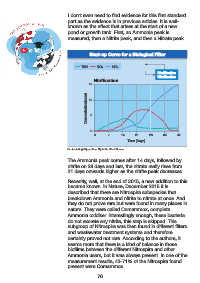
                             algae we extract from our ponds, or we create shade                                 measured, then a Nitrite peak, and then a Nitrate peak.
                             making it a lot harder for the algae to grow. If you have
                             more algae as autotrophs and your Ammonia level in the
                             pond (with some sun) goes up, then you get algae growth.                                     Start-up Curve for a Biological Filter
                             Thus remain the autotrophic and heterotrophic bacteria
                                                                                                                       TAN   NO ²   NO ³
                             but actually also two other routes which were not
                                                                                                                                                       Biofiltration
                             discussed in this article because they did not apply here.                                                                Nitrification
                             There are also routes without oxygen namely                                                    Nitrification
                                                                                                                          15
                             Denitrification and Anammox. In the next article these are
                             described in more detail.
                             First the standard Autotroph bacteria. The basis of                                          10
                             Nitrogen Flow (no ‘Cycle’) like it is always learned and                                    Concentration (ppm)
                             taught in the Koi world. As is known, nitrification and the                                 Removal Rate (g/m 3  per day)   5
                             degradation of nitrite by Nitrosomonas and Nitrobacter
                             among others convert Ammonia to nitrate via nitrite (in the
                             following diagrams). Degradation to Nitrite by bacteria                                       0
                             from Nitrosomonas, Nitrosococcus, Nitrosolobus,                                                0     7    14    21    28    35    42
                                                                                                                                          Time (Days)
                             Nitrospira and Nitrosovibrio, breakdown of Nitrite by
                             Nitrobacter, Nitrococcus, Nitrospira and Nitrospina. These                          Recirculating Aquaculture Systems Short Course.
                             processes give the bacteria energy to continue to do
                             everything in the bacterial cell.                                                   The Ammonia peak comes after 14 days, followed by
                                                                                                                 nitrite on 28 days and last, the nitrate really rises from
                             A schematic overview of most processes                                              21 days onwards higher as the nitrite peak decreases.
                             looks like this:
                                                                                                                 Recently, well, at the end of 2015, a new addition to this
                                              The Nitrogen Cycle
                                                                                                                 became known. In Nature, December 2015 it is
                                                                                                                 described that there are Nitrospira subspecies that
                                                                                                                 breakdown Ammonia and nitrite to nitrate at once. And
                                                                                                                 they do not prove rare but were found in many places in
                                N org    NH 4 +                  NO 2 -   NO -                                   nature. They were called Comammox, complete
                                                                            ³
                                                                                                                 Ammonia oxidiser. Interestingly enough, these bacteria
                                                             NO                                                  do not excrete any nitrite, this step is skipped. This
                                                                                                                 subgroup of Nitrospira was then found in different filters
                                                      N 2 O                                                      and wastewater treatment systems and therefore
                                               N 2
                                                                                                                 certainly proved not rare. According to the authors, it
                                    Ammonia Oxidation to Nitrite (Nitritation)  Complete Ammonia Oxidation to    seems more that there is a kind of balance in those
                                                            Nitrate (Comammox)
                                    Nitrite Oxidation to Nitrate (Nitratation)                                   biofilms between the different Nitrospira and other
                                    Anammox Process         Dissimilatory Nitrate Reduction
                                                            to Ammonium (DNRA)
                                    Denitrification                                                              Ammonia users, but it was always present. In one of the
                                                            Nitrogen Fixation
                                                                                                                 measurement results, 43-71% of the Nitrospira found
                                 Intermediates for Nitritation, Comammox and Anammox are not depicted.
                                                                                                                 present were Comammox.
                                          75                                                                                  76

