


Page 77 - Koi Net - On-Line Koi Magazine - Issue 92
P. 77
It is quite logical that the autotrophe system is the main                          So far, the Koi hobby has often looked at the wastewater
                             mechanism, at least regarding the values we measure.                                industry in terms of the bacteria that convert Ammonia
                             Once the ponds are matured we normally only measure                                 to nitrate via nitrite. One of the nice things that has
                             some increased nitrate values from time to time, but                                been determined is there is the percentage of nitrogen
                             that was it. And so Ammonia or nitrite can disappear                                used for cell growth in those systems. It is determined
                             directly what we don’t know about? And an excess of                                 that 0.124 grams per gram of Ammonia is used for cell
                             nitrate will disappear somewhere, right? It doesn’t keep                            growth. So say 12.4%, and that in the optimal
                             accumulating, so it’s going somewhere, it has to.                                   circumstance whilst there is always a huge amount of
                             Bacterial growth in which nitrogen is used also                                     Ammonia available to the bacteria. In our ponds, that
                             increases in a pond, but at some point it reaches a                                 percentage will not be higher. Of this amount, also by far
                             balance if there is simply no longer food for them, but I                           the highest percentage is for heterotrophic bacteria, and
                             will explain this in more detail later on.                                          only a small (negligible) percentage for the growth of
                                                                                                                 autotrophic bacteria. What was that again? Heterotrophic
                             In the fish culture industry, many details are now known                            bacteria extract their energy from converting organic
                             about RAS systems and their biofilters. As an average                               compounds (substances containing C, carbon) such as
                             directive, it can be assumed that for each gram of TAN                              sugar/sucrose (C 12 H 22 O 11 ) and autotrophic bacteria (the
                             (nitrogen from/in Ammonia) 4.57 grams of oxygen is                                  nitrifying bacteria) extract their energy from substances
                             needed to eventually convert it into Nitrate. It has also                           that are inorganic (such as Ammonia and nitrite that do
                             been determined that as long as the oxygen level                                    not contain carbon).
                             remains above 4mg/l, this whole process works fine. It
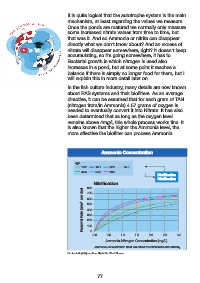
                             is also known that the higher the Ammonia level, the                                The heterotrophs do use Ammonia, but in the presence
                             more effective the biofilter can process Ammonia.                                   of a carbon source like glucose. The stoichiometric
                                                                                                                 equation, so the comparative molecular formula
                                                                                                                 indicates this can be made as follows:
                                                                                                                                           -
                                            Ammonia Concentration                                                NH 4  + 1.18 C 6 H 12 O 6  + HCO 3  + 2.06 O 2  forms
                                                                                                                     +
                                                                                                                 C 5 H 7 O 2 N + 6.06 H 2 O + 3.07 CO 2
                                Lpm
                                   13.2  15.7  22.0  30.5
                                                                                                                 If bacteria grow, they use nitrogen to eventually form
                                   44.6  54.2  80.6
                                                                   Biofiltration                                 C 5 H 7 O 2 N. This is the average molecular presentation of
                                                                   Nitrification                                 biomass. Carbonate, Ammonia and glucose are used to
                                        Nitrification
                                                                                                                 make biomass, water and CO 2 . This process also
                                     800
                                    Removal Rate (g/m 3  per day)  600                                           become harmful to our Koi if their concentration in the
                                                                                                                 goes the other way when a bacterium dies. These
                                     700
                                                                                                                 heterotrophic bacteria grow faster which can also
                                     500
                                                                                                                 pond becomes too high. Often this happens when there
                                     400
                                                                                                                 is too much dirt present in the pond and the biological
                                     300
                                                                                                                 material goes ‘rotten’. How large is the amount of
                                     200
                                     100
                                                                                                                 heterotrophic bacteria? This effect seems to depend on
                                       0
                                        0.0  0.5   1.0   1.5   2.0   2.5   3.0                                   nitrogen that is captured in ponds as growth of
                                                                                                                 the protein percentage of the food fed. We still know
                                             Ammonia-Nitrogen Concentration (mg/L)
                                                                                                                 from the first part of this series of articles that in the Koi
                                        Ammonia concentration itself will affect the nitrification rate directly.
                                                                                                                 world about 40-45% protein content in the food is used.
                             Recirculating Aquaculture Systems Short Course.
                                          77                                                                                  78

