


Page 50 - Koi Net - On-Line Koi Magazine - Issue 78
P. 50
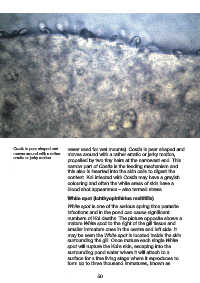
Costia is pear shaped and   never used for wet mounts). Costia is pear shaped and   White spot is one of the   swarmers. Each swarmer must find another fish to
       moves around with a rather   moves around with a rather erratic or jerky motion,    most serious parasite   infect within 12 hours, but in the Koi pond this tips the
       erratic or jerky motion.                                                            infections and if not
                             propelled by two tiny hairs at the narrowest end. This        treated will cause    balance in favour of the White spot, as the swarmers
                             narrow part of Costia is the feeding mechanism and            significant numbers of   can easily find a Koi to infect!
                             this also is inserted into the skin cells to digest the       Koi deaths.
                                                                                                                 It is important to treat once White spot has been
                             content. Koi infected with Costia may have a greyish
                                                                                                                 detected, but the treatment only eradicates the free
                             colouring and often the white areas of skin have a
                                                                                                                 living stage. Once a swarmer has burrowed under
                             blood shot appearance – also termed stress.
                                                                                                                 the skin of the Koi it is not affected by the pond
                             White spot (Ichthyophthirius multifilis)                                            treatment.
                             White spot is one of the serious spring time parasite                               Koi affected by White spot have characteristic white
                             infections and in the pond can cause significant                                    pimples scattered over the body surface, including
                             numbers of Koi deaths. The picture opposite shows a                                 the eyes and gills, the fish is listless, often with fins
                             mature White spot to the right of the gill tissue and                               clamped. In the late spring, early summer male Koi
                             smaller immature ones in the centre and left side. It                               often develop spawning rash, which may have the
                             may be seen the White spot is located inside the skin                               appearance of White spot but the skin has a rough
                             surrounding the gill. Once mature each single White                                 feel, which extends to the pectoral fins. Spawning
                             spot will rupture the Koi’s skin, escaping into the                                 rash is never found on the eyes or gills and these Koi
                             surrounding pond water where it will attach to a                                    are fit and lively.
                             surface for a free living stage where it reproduces to
                             form up to three thousand immatures, known as


                                          50                                                                                  51

